COVID-era inflation caused pet food retail prices to jump 24.9% between January 2020 and August 2026, with much of that increase remaining permanent even after inflation subsided. This represents nearly three times more growth than the entire previous decade, marking a lasting shift in pet food pricing.
- Pet food retail prices rose 24.9% from January 2020 to August 2026, compared to only 8.8% growth during the entire preceding decade
- Producer prices increased approximately 27.5% from June 2021 to March 2023, with a several-month lag before retail price acceleration
- After inflation peaked in May 2023, prices stabilized at the higher level rather than declining, indicating a permanent price reset
- Without COVID disruptions, pet food prices would have reached approximately 164.6 by August 2026, but instead reached 194.485—about 18% higher
- Current inflation rates have slowed to 1.6% annually for retail pet food, but prices remain far above pre-pandemic trajectory levels
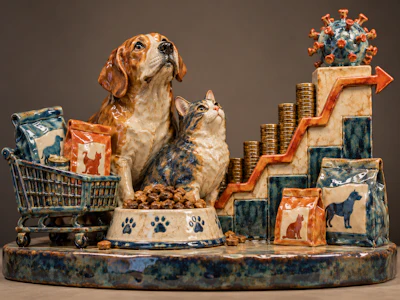
Of all the new-normals we heard about during the pandemic, higher prices seem to be the normal that remained after the masks came off. The COVID-era inflation surge may have permanently raised not only U.S. pet food producer prices, but also the prices pet owners pay at retail (see infographic below).
The U.S. Bureau of Labor Statistics Consumer Price Index (CPI) for pet food and treats stood at 194.485 in August 2026, compared with 155.686 in January 2020, an increase of approximately 24.9%.
That increase contrasts sharply with the decade before the pandemic. The pet food and treats CPI increased from 143.085 in January 2010 to 155.686 in January 2020, or only about 8.8% over 10 years.
In other words, retail pet food prices increased almost three times as much from January 2020 through August 2026 as they had during the entire preceding decade.
BLS defines the CPI as the average change over time in prices paid by consumers for goods and services. The pet food and treats series covers prices paid by U.S. urban consumers.
Retail prices initially remained flat
As with pet food producer prices, the consumer price increase did not begin immediately with the onset of COVID-19.
The pet food and treats CPI was 155.686 in January 2020 and 155.513 in June 2021, meaning retail prices were essentially unchanged during the first 18 months of the pandemic.
Producer prices followed a similar pattern initially. The BLS Producer Price Index for dog and cat food manufacturing increased from 230.3 in January 2020 to 232.5 in June 2021, only about 1%.
The trajectories began to separate during the second half of 2021.
Producer prices jumped from 232.5 in June 2021 to 240.515 in July, then continued climbing through 2022. By March 2023, the dog and cat food manufacturing PPI had reached 296.427, up approximately 27.5% from June 2021.
Retail prices moved more slowly at first.
The pet food CPI increased from 155.513 in June 2021 to just 158.730 by December 2021. The acceleration became much more pronounced during 2022, when the index climbed from 159.179 in January to 182.820 in December.
That pattern suggests a several-month lag between the initial producer-price shock and the strongest retail price increases, although the BLS indexes alone cannot establish that producer prices directly caused the subsequent retail increases.
Retail pet food prices rose nearly 24% during the surge
By May 2023, the pet food and treats CPI had reached 192.666, up approximately 23.9% from June 2021.
That increase was somewhat smaller than the roughly 27.5% increase in dog and cat food producer prices over the principal producer inflation period.
The difference is important because the two indexes measure different stages of the supply chain. The PPI measures prices received by domestic producers, while the CPI measures prices consumers pay at retail.
Comparing percentage changes rather than index levels indicates that a substantial portion of the producer-price increase coincided with higher consumer prices, but not on a one-for-one basis.
Other factors between manufacturing and the consumer — including retailer margins, promotions, transportation, distribution and product mix — may influence the final retail price.
Inflation faded, but retail prices stayed high
The strongest evidence of a lasting price reset comes from what happened after inflation subsided.
After reaching 192.666 in May 2023, the pet food CPI fluctuated within a relatively narrow range. It declined modestly during 2024, reaching 188.882 in December 2024, before moving upward again during 2025 and 2026.
By August 2026, the index stood at 194.485, approximately 0.9% above its May 2023 level and close to its highest level in the series.
Meanwhile, producer prices followed an even flatter post-surge pattern. The dog and cat food manufacturing PPI was 296.427 in March 2023 and 304.254 in August 2026, an increase of approximately 2.6%.
The parallel patterns suggest that both parts of the market entered a new pricing regime: a rapid upward adjustment followed by relatively stable prices at a much higher level.
Retail prices remain far above their pre-COVID trajectory
The contrast with the earlier trend is especially striking.
From January 2010 through January 2020, consumer pet food prices increased at a compound annual rate of only about 0.85%.
If that rate had continued after January 2020, the pet food CPI would have reached approximately 164.6 by August 2026.
Instead, it reached 194.485.
That puts consumer pet food prices approximately 18% above an extrapolation of their 2010–2020 trajectory.
The comparison does not prove that COVID-19 caused the entire difference. The period also included commodity inflation, labor shortages, transportation disruptions, packaging cost increases, geopolitical shocks and other factors affecting food manufacturing and retailing.
However, the timing is clear: the longstanding, relatively flat pet food retail price trend broke sharply beginning in late 2021 and 2022, following the earlier acceleration in producer prices.
Producer and consumer prices tell similar stories
By August 2026, dog and cat food producer prices were approximately 32.1% higher than in January 2020, while consumer pet food and treat prices were approximately 24.9% higher.
Inflation rates have since slowed considerably.
In August 2026, the pet food and treats CPI was up 1.6% from a year earlier, while the dog and cat food manufacturing PPI was up approximately 1.1% from August 2025.
The slowdown does not mean prices returned to their previous levels.
Instead, both indexes point toward the same post-COVID outcome: the rapid inflation surge ended, but much of the higher pet food price level remained.
Data sources
U.S. Bureau of Labor Statistics, Consumer Price Index for All Urban Consumers: Pet Food and Treats in U.S. City Average, series CUUR0000SS61031.
Pet food and treats CPI data
U.S. Bureau of Labor Statistics, Producer Price Index by Industry: Dog and Cat Food Manufacturing, series PCU311111311111.
Dog and cat food manufacturing PPI data
 Tim Wall | DALL-E