In the book “What to Eat When: A Strategic Plan to Improve Your Health and Life Through Food,” two doctors discussed the importance of eating not just the right foods, but also when to eat those foods. The doctors pointed out that individual goals, life stages and personal biology all play a role in determining one’s ideal diet patterns, as opposed to immutable universal rules of nutrition. Along with the chemistry of nutrition, eating certain foods at the right times of day influences human health and well-being.
As with many other health trends, the lessons of “What to Eat When” can be applied to the pet food industry. Feeding directions on cat food packages typically concentrate on “how much” to feed per day, often leaving “how often” to owners' preferences. However, especially in aging cats, the animals' preferred feeding patterns may not match owners' schedules, according to research published in the journal Animals.
Aging cats’ appetites can be affected by changes in smell and taste, dental health and cognition. These cats may be at risk of losing lean body mass if energy intake drops too low. In-home research helps define what normal looks like for older cats when they are allowed to choose their own feeding schedule, and it highlights differences among wet, dry and mixed feeding regimens that pet food companies can translate into clearer consumer guidance.
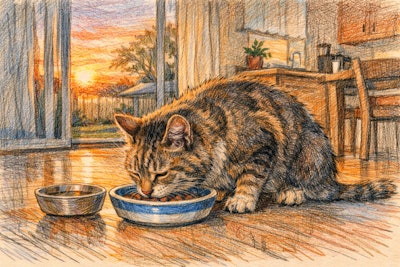
In a randomized, crossover study, researchers monitored 134 healthy cats ages 7 and older for 24-hour feeding behavior in their owners' homes. The cats ate under three ad libitum regimens: dry only, wet only, and a wet-plus-dry combination. Cats used automated feeders with built-in scales that recorded eating occasions and intake. Across regimens, cats ate multiple small meals rather than a few large ones, clustering consumption around morning and late afternoon.
“We have shown that aging pet cats eat 6 or 7 small meals throughout the day with feeding peaks around dusk and dawn and feeding troughs in the middle of the day and night,” the scientists wrote. The researchers worked for Royal Canin and Waltham Petcare Science Institute, both owned by Mars Petcare.
Older cats daily feeding cycles
When cats had constant access, the average meal count was about six meals per day on dry food, and closer to seven meals per day on wet or mixed wet/dry regimens. The feeding peaks occurred at 6 a.m. to 9 a.m. and 4 p.m. to 7 p.m., consistent with a dawn-and-dusk rhythm reported in other feline research.
Format also affected energy intake. Average daily calorie consumption was highest on dry (262.6 kilocalories per day), intermediate on mixed feeding (222.6 kilocalories per day) and lowest on wet-only feeding (138.1 kilocalories per day), with wet significantly lower than both dry and mixed. The authors noted that the wet-only intake fell below an example estimate for a 4-kilogram adult cat’s daily energy needs (about 208 kilocalories per day, based on a published equation), while dry-only exceeded that. They also cautioned that the study did not track body weight during the test periods, and short-term intake patterns may not predict long-term adaptation.
Water intake results underscored the classic trade-off between formats. Cats drank more water voluntarily on dry, but total water intake (drinking plus dietary moisture) was far higher on wet (179.3 grams per day) than dry (65.9 grams per day), with mixed feeding in between (139.2 grams per day). The paper linked higher-moisture feeding to urinary dilution findings in earlier studies, a topic many brands already address in consumer education.
Comparison with current directions
Senior-cat feeding advice in veterinary guidelines often emphasizes multiple small meals. The American Association of Feline Practitioners senior care guidance, as cited by the study authors, suggests three or four small meals daily for older cats. However, the in-home observations suggest that, under free-access conditions, many healthy aging cats naturally distribute intake even more frequently, roughly six to seven meals per day. While expecting cat owners to actually provide seven individual feedings is a bit much, it does provides a science-based behavioral reference point that can make feeding instructions feel less arbitrary to owners.
For wet foods in particular, the findings are a reminder that “one pouch, twice a day” may underserve energy needs for some older cats if owners do not adjust for calorie density. For dry foods, the higher intake and high variability observed in the study points to the opposite risk: some cats may overconsume if free-fed, especially in indoor lifestyles. Mixed feeding landed in the middle for calories while preserving a higher total moisture intake than dry alone, which the authors concluded could help balance calorie intake and hydration-related benefits for aging cats.
“The feeding guidelines for aging cats (≥7 years) should recommend feeding several small meals per day using a combination of wet and dry formats to satisfy the aging cat’s grazing behavior, balance calorie intake, and support urinary tract health benefits,” the researchers wrote.