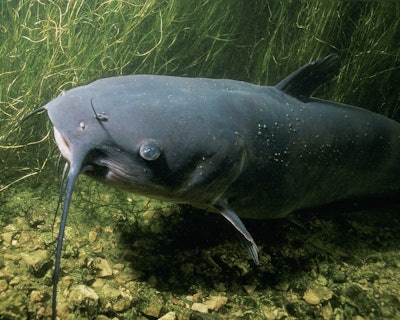
The House Natural Resources Committee unanimously approved legislation that would establish federal funding for pet food and animal feed manufacturers to incorporate invasive blue catfish from the Chesapeake Bay into their products.
The Mitigation Action and Waterman Support (MAWS) Act, introduced last July by Representatives Sarah Elfreth (D-MD-03) and Rob Wittman (R-VA-01), would create a two-year pilot program within the National Oceanic and Atmospheric Administration (NOAA) Chesapeake Bay Office to develop market infrastructure for blue catfish in the pet and animal food industries.
"Invasive blue catfish pose a direct ecological and economic threat to the Chesapeake Bay, which is why I introduced the bipartisan MAWS Act alongside Vice Chair Wittman to address the damage inflicted by blue catfish, while also strengthening our local seafood economy and providing a new source of protein to pets nationwide," said Elfreth, who co-chairs the Chesapeake Bay Watershed Task Force with Wittman. "While we can all do our part and order Blue Catfish when we see it on a menu — it's delicious — this is not a problem that we alone can eat our way out of."
Under the program, the NOAA would administer grants to pet and animal food manufacturers to establish transportation, processing and manufacturing infrastructure for blue catfish while incentivizing watermen to harvest the invasive species.
Blue catfish, which have no natural predators in the Chesapeake Bay Watershed, can live up to 20 years and weigh up to 100 pounds. The species feeds on blue crabs, rockfish, striped bass and oysters.
Blue catfish are not only contributing to the ecological biodiversity challenge of the Bay, but also causing significant economic damage to Maryland and Virginia's seafood industries. They are now the most abundant biomass in the Chesapeake Bay. Despite being safe and nutritious for human consumption, watermen are struggling to sell enough blue catfish to combat the rapidly growing population, partially due to a rule that redirects inspection for this species to the USDA, unlike every other fish that is inspected through the FDA.
"Having spent my life near the Chesapeake Bay, I understand how urgent it is that we protect the Bay's delicate ecosystem from blue catfish," said Wittman. "Blue catfish are an invasive species, and they're threatening the biodiversity of the Bay. The MAWS Act will facilitate a new market for these fish — protecting the seafood industry from economic harm and preserving the health of the Bay."
The bill has nine co-sponsors: Representatives Steny Hoyer (D-MD-05), Jen Kiggans (R-VA-02), Glenn Ivey (D-MD-04), April McClain Delaney (D-MD-06), Kweisi Mfume (D-MD-07), Johnny Olszewski (D-MD-02), Bobby Scott (D-VA-03), Paul Gosar (R-AZ-09), and Celeste Maloy (R-UT-02). Fourteen organizations have endorsed the MAWS Act since its introduction.
The legislation now moves to the House floor for a vote.