EDITOR’S NOTE: A full reference list for this study is available upon request. Please contact the authors or Petfood Industry for more information.
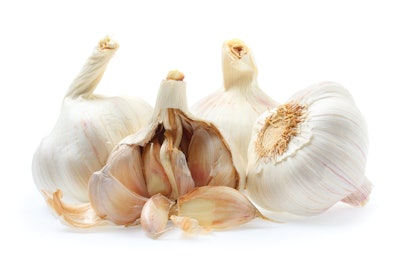
Garlic (Allium sativum) is a common ingredient found in many human foods and is often praised for its antimicrobial properties. Although garlic is a generally recognized as a safe (GRAS) ingredient for use in animal feed by the U.S. Food and Drug Administration (FDA) and is approved by the Association of American Feed Control Officials (AAFCO) for use in pet food, its use in dog treats remains a controversial topic. Some pet owners swear by garlic’s health benefits, while others may raise an eyebrow and wonder how safe it really is for their dogs.
Allicin is the compound responsible for garlic's antimicrobial properties and physiological effects. Fresh garlic contains on average 3.5 mg allicin/g fresh weight; equivalent to 9.5 mg allicin/g dry mass (Lawson, 1998). However, because allicin degrades with heat and processing, dehydrated garlic has a lower concentration of allicin compared to fresh garlic. The published concentration of allicin in dried garlic is on average 6.0 mg allicin/g dry mass (Ratti et al., 2007; Doganturk et al., 2019).
General information about garlic
Garlic, scientifically known as Allium sativum, is a widely used food and spice known for its strong odor and flavor. Fresh garlic is commonly utilized in cooking, while dehydrated garlic is commonly used as a seasoning in both household cooking and in the food industry. Garlic is known for its medicinal properties and antimicrobial activities. The compound responsible for these properties is allicin, which is present in a variety of plants belonging to the Allium species, including onions, leeks, garlic and chives. Allicin is formed when garlic is physically altered by chopping, crushing or grinding. Physically altering garlic releases the enzyme alliinase (Granroth, 1970) that causes the formation of allicin from S-allyl-L-cysteine sulfoxide (alliin) (Cavallito et al., 1945).
Garlic is most often available as a dehydrated product and the body of literature suggests that allicin concentrations decrease during dehydration (Hoshino et al., 2001). That means the upper tolerable limit of garlic is likely much greater when dehydrated garlic is included in dog treats, as opposed to fresh garlic.
Garlic also contains other organosulfites, specifically alkenylcysteine sulfoxides that provide the odor, flavor and pharmacologic effect (Ferary and Auger, 1996). However, not all garlic products contain significant amounts of allicin, and in vivo research suggests that organosulfur compounds derived from allicin may not be readily bioavailable (see Table 1).

Table 1: Not all garlic products are created equal when it comes to allicin amounts and bioavailability.
Manufacturers whose products contain garlic should consider measuring these compounds. They must also understand the overall chemical composition of the treats and the variability from batch to batch when the same formulation is used under similar processing conditions.
What is the concern about feeding garlic to dogs?
Concern about garlic ingestion in dogs and cats is due to the finding that catalase protein expression is low in dogs (Nakamura et al., 1998) and hemoglobin in cats is more susceptible to oxidative damage than in other species (Harvey et al., 1976). However, the dose of garlic is a very important consideration. Dose-dependent toxicity refers to the idea that the effects of a substance on the body can vary depending on the amount consumed. Safe and toxic levels of a substance are defined by the range of doses that are unlikely to cause harm and the amount that can lead to adverse effects, respectively. Dogs consuming toxic amounts of garlic can experience oxidative hemolysis and a reduction in oxygen-carrying capacity and oxygenation of tissues. This can lead to cardiac and smooth muscle relaxation, vasodilation and low blood pressure (Malik and Siddiqui, 1981; Martin et al., 1992). Although specific breed sensitivity to garlic ingestion has not been studied, the red blood cells of certain breeds, including English Setters, Whippets and Boxers, appear more sensitive to oxidative damage (Caldin et al., 2005), likely making these breeds more susceptible to garlic toxicity. It is important to note that this topic has not been studied in detail.
Additionally, consuming large amounts of garlic can potentially cause depression, urine discoloration, rapid breathing, increased heart rate, weakness and sensitivity to cold (Cope, 2005). Symptoms of toxicity can appear within a day but may also develop several days after consumption. Allium species toxicosis most commonly occurs after the consumption of fresh plant material, such as meadow garlic (Allium canadense) or wild garlic (Allium vineale) (Cope, 2005). But these results may not be directly applicable to dehydrated garlic powder or other forms of garlic commonly found in dog treats.
The compounds found in garlic, specifically organosulfites like allicin, are metabolized to highly reactive oxidants that can cause these adverse effects, such as oxidative hemolysis (Amagase et al., 2001). Oxidation of beta-93 cysteine residues present in hemoglobin results in the formation of sulfhemoglobin (Bloom et al., 2001), a compound not normally present in healthy animals. Sulfhemoglobin is less soluble than hemoglobin and will therefore precipitate, aggregate and bind to the cell membrane, forming Heinz bodies and increasing extravascular hemolysis and causing dysregulation in cell membrane function and the sodium-potassium pump.
In the case of garlic toxicity in dogs, understanding safe and toxic doses is a primary consideration when considering the addition of garlic to a dog or cat food, treat or supplement. While it is true that garlic can be toxic to dogs, the amount needed to experience harmful symptoms is extremely high. Although the National Research Council’s Committee on Examining the Safety of Dietary Supplements for Horses, Dogs and Cats lists a presumed safe intake of garlic as 56 mg per kg body weight in dogs, the committee was not able to publish a safe upper limit for dietary garlic due to lack of published data on the subject (National Research Council, 2009).
A study by Cope (2005) found that dogs consuming 15 g of onion per kg body weight had hematologic changes that were of clinical significance. This threshold is often cross applied to all other Allium species, including garlic; despite garlic being considered less toxic than onion for dogs and despite evidence to support this recommendation (Kovalkovičová et al., 2009). For a 10-pound dog, this threshold would be equivalent to 22 cloves of garlic, while a larger dog would need to consume much more. Considering garlic specifically, dogs fed the equivalent of 5 g of whole garlic per kg body weight as garlic extract for 7 consecutive days experienced reduced erythrocyte count, hematocrit and hemoglobin, but no dogs developed anemia (Lee et al., 2000). Eccentrocytes were also detected in these dogs. Eccentrocytes are erythrocytes capped with a clear crescent-shaped structure and are used to indicate exposure to foods (garlic and onions), drugs or nutrient toxicity (i.e., zinc). Although no dogs developed anemia, these clinical findings were sufficient to warrant advice to not feed garlic to dogs.
To our knowledge, there is only one published case study of a dog that developed hemolytic anemia after consuming an estimated 60 g of baked garlic in one instance (Kang and Park, 2010). Although the breed of the dog was listed as Schnauzer, the body weight of the dog was not included and any other variables that may have confounded these effects were also unknown.
Data in support of dietary garlic for dogs
Despite the information on potential toxicity, other existing data suggest a benefit of dietary garlic. Turek et al., (2000) fed Beagles a complete diet containing 0.5% garlic powder on a dry matter basis (approximately 80–110 mg of garlic powder per kg body weight) for 77 days to investigate the effects of garlic on immune response. The inclusion of garlic in up to 10 g/kg diet improved antioxidant status and provided immunomodulatory effects (increased lymphocyte blastogenesis) that suggested anti-cancer benefits. Although the authors observed an enhanced immune response in the dogs, they did not report any physiological changes or complete blood count values (erythrocyte count, hematocrit and hemoglobin), making it difficult to assess the effects on gross health markers commonly used to diagnose allicin poisoning.
It is notable that the authors later applied for a patent for the inclusion of garlic at 0.1-1% (1 to 10 g/kg diet) to enhance immune response in dogs (Hayek et al., 2003). This patent was not granted and there is freedom to practice given that 20 years have passed. It may be useful for the pet food industry to support simple clinical trials if interested in claiming potential benefit space around garlic supplementation and immune enhancement.
Conclusions
Based on the limited body of literature available on both the detrimental and beneficial effects of dietary garlic consumption, the inclusion of dehydrated garlic in low quantities in dog treats does not pose a health risk to dogs. Pet owners can rest easy knowing those garlicky treats won’t harm their beloved pets.