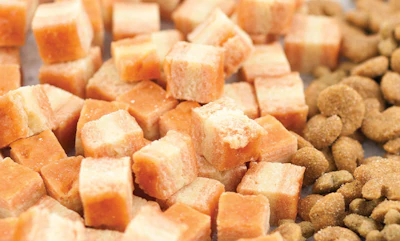
Freeze-dried pet food is no longer a novelty. It's a category with staying power that's showing up in more bowls, attracting more manufacturing investment and inspiring more ingredient innovation.
What pet owners are actually doing
Shannon Landry, research director for pet at Packaged Facts, said pet owners are mixing and matching their way to customized feeding routines, and alternative formats like freeze-dried are a meaningful part of that.
"About two-thirds of pet owners said that they will at least occasionally add something to their pet's bowl," Landry said. That behavior, which she described as flexible or supplemental feeding, spans everything from wet food and human food toppers to fresh, gently cooked formulations, freeze-dried and air-dried products, and raw pet foods. The common thread is intentionality. Pet owners aren't just filling a bowl, they're curating a meal.
Why? Landry's survey data points to variety and interest as the top motivator, followed closely by health and wellness benefits. Encouraging a picky eater and adding hydration (particularly among cat owners) round out the list, she noted. The health-and-wellness angle connects directly to why alternative formats are gaining ground. Nearly 70% of pet owners surveyed by Packaged Facts agreed that they worry about the healthfulness of processed pet foods, a figure that helps explain the appeal of freeze-dried products, which are widely perceived as less processed than traditional kibble.
Humanization of pets is also a factor Landry said. "Pet owners think of their pets as members of the family,” she said. “This humanization has driven them to formulations that more closely resemble human foods, both in how they are produced and how they look."
Packaging transparency, the kind that lets a pet owner see exactly what's in the bag, has become a market differentiator, and freeze-dried and fresh formats benefit from that trend, she said.
The economics, however, are not uncomplicated. Landry was candid about price pressure on pet food shoppers, noting that high cost of pet food ranked at the top of the list when consumers were asked about significant challenges of pet ownership.
But value, she emphasized, is not synonymous with low price. For the growing segment of pet owners who see premium alternatives as worth the spend, value means quality ingredients and tangible health benefits, not the cheapest option on the shelf.
What can you freeze dry?
Sean Jones, director of sales at Glacial Freeze Dry, said pet food manufacturers should stop leaving margin on the table, encouraging them to keep asking, "Can you freeze dry that?"
His point isn't about any single ingredient. It’s about the underutilized raw materials and nonstandard inputs already embedded in existing supply chains — byproducts, organ meats, trimmings, unusual cuts — that could, with the right processing approach, become premium freeze-dried products with strong margin profiles.
The example he used was duck heads: a product that might once have gone to rendering but is now selling for $7 to $10 per unit in pet stores. He noted that one processor is currently freeze drying 11,000 pounds of duck heads per week.
Jones drew a parallel to a well-known food history moment. He pointed out chicken wings were once discarded. "There was a time when you couldn't go to a local restaurant and order chicken wings,” he said. “Those were discarded in the 1970s and 80s." The implication: today's overlooked input could be tomorrow's high-demand SKU.
The caveat is that supply chain opportunity and actual product viability aren't the same thing. Jones was clear that two factors determine whether an ingredient makes sense to freeze dry: the cost of the input and the cost of processing it.
Getting a raw material for free doesn't guarantee margin if the freeze-drying run is long, complex or technically demanding, he added. Duck heads, for instance, require customized wider shelves and significantly longer run times than standard proteins, potentially two or more days per cycle.
"Even though it might be a completely free ingredient and will make a great end product – how much does it cost to process? The answer to that might determine what your overall margin is,” Jones said.
He also raised the challenge of supply consistency. Wild boar was a product he used as a cautionary example — a viable freeze-dried ingredient that largely disappeared from the market when supply became unreliable. Whatever the input, he said, manufacturers need to ensure consistent and reliable availability before committing to it as a core product line.
The format evolution Landry described from a consumer perspective — more toppers, more mix-ins, more premium add-ons — maps directly to Jones' argument.
"Toppers are a big part of it," he said. “Even manufacturers with conventional outputs could potentially freeze dry certain ingredients, grind them, and reposition them as toppers with a compelling nutritional story.”
Jones acknowledged that some ideas are great in concept but difficult in practice. Complex formulations, exotic proteins and novel inputs don't always survive cost modeling.
“It might be the best product in the world, but if it’s $25 an ounce, most people won’t buy it,” he explained.
Scaling batch operations without losing efficiency
Matt Graunke, freeze dry sales executive at Parker Freeze Dry, said understanding freeze drying's fundamental operating principles is the key to integrating it successfully into a pet food manufacturing line.
Freeze drying is, by physics, a batch process, he explained. The door closes, the air comes out, and the cycle runs. Facilities built around continuous-operation models need to plan for that distinction from the start.
"In a traditional pet food operation, everything is pending on conveyors, and it's always continuous," Graunke said. "Freeze drying requires a batch process."
Graunke said combining the two processes is manageable with some ingenuity. The approach he laid out involved three interlocking elements: automation of repetitive pre- and post-dryer tasks, intelligent staggered scheduling across multiple chambers, and advanced multi-compressor refrigeration design.
"The key takeaway is that freeze drying can function as part of a near-continuous production system when batch operations are intentionally automated, scheduled and engineered together," Graunke said.
On automation, he focused on the pre- and post-dryer steps that are most prone to inconsistency: pan loading, cart handling and weight standardization.
"Inconsistent inputs will provide inconsistent results," he said. "It's ‘garbage in, garbage out’ in its purest form. Standardizing how much product goes into each pan, and automating the loading and unloading process, removes a major source of variability and reduces labor demand.”
On scheduling, he walked through a detailed example: a facility that needed to hit a target yield of 7,000 pounds per day, working backward from batch times and yields per pan to determine that eight chambers running on a staggered schedule could meet that goal. Graunke's framework treats scheduling as a math problem — once the inputs are known, the rest follows. “Once it's set up correctly, it actually becomes stable and predictable," he said.
The refrigeration architecture he described supports that staggered model. Rather than a one-to-one relationship between compressor and chamber, a multi-compressor system can serve five chambers from a shared refrigeration rack, with nine compressors cycling on as needed. That setup, he explained, reduces energy waste and speeds up defrost cycles — one chamber can be defrosted using cold generated for the other four.
Graunke noted the importance of discipline: the danger of deviating from an optimized model once it's working. Adding an extra pound to every pan might seem like a small efficiency gain, he explained. But run the numbers across 52 weeks of batches and it becomes a six-hour-per-batch time penalty that cascades through the entire production schedule.
"If you're not paying attention to what's really going on and doing the math, you could be missing out on some time and some revenue,” he said.
Looking ahead, Graunke sees the industry moving toward KPI-driven operations and AI-assisted decision-making.
"It's not going to be long before we’re able to take all these inputs and all these data points and put them into an AI agent that can help us make these decisions," he said. “This has the potential to reduce trial-and-error runs and sharpen optimization in ways that current monitoring alone can't achieve.”
The bigger picture: momentum
Consumer behavior is shifting toward premium, perceived-as-healthier formats, and flexible feeding has turned freeze-dried toppers and add-ons into a mainstream purchase pattern. That demand is pulling ingredient innovation upstream, where suppliers are rethinking what belongs in a freeze dryer. And it's pressing manufacturers to solve the operational challenges that come with scaling a batch process in a continuous-production world.
Graunke said the infrastructure to support that growth is the work now underway.
"Freeze-dried pet food will transition from a specialty process to a standardized, scalable manufacturing model in the next five years,” he concluded.