Demand for natural colorants in pet food is growing as the industry moves away from synthetic dyes — a shift accelerating in part because the FDA is requiring a phase-out of several synthetic dyes in human foods, and pet food trends tend to follow human food trends, said Dr. Joy Campbell, senior director of global pet food technical service at APC.
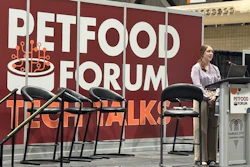
On the Tech Talk stage at Petfood Forum 2026, Campbell presented data on spray dried red blood cells as a natural coloring ingredient, explaining how the product works in both wet and dry formulations.
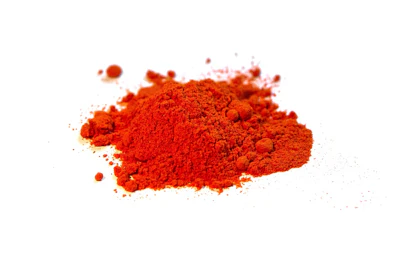
The ingredient, which APC markets as AP 301, is a spray-dried red blood cell powder containing 92% protein. Campbell noted that manufacturers can use it at low inclusion levels to affect color while also receiving a protein credit in formulation. The product is available in porcine or bovine options and can be labeled as spray dried animal blood cells, animal blood cells or meat by-product, depending on labeling preferences.
"You don't need very much to actually impact the color," Campbell said.
 Dr. Joy Campbell with APCLisa Cleaver
Measuring color change
APC quantified color impact using the Hunter Lab color scale, which measures lightness (L), red-green axis (A) and yellow-blue axis (B) values. These are combined into a Delta E score, where a lower number indicates a darker color.
In wet pâté testing, APC ran trials at 0%, 0.25%, 0.5%, 1%, 2% and 3% inclusion levels, replacing chicken carcass with AP 301. Delta E scores dropped from 58 in the control to 34 at higher inclusion levels in initial tests. Campbell described the response as linear — the more AP 301 added, the darker the product.
Trials also tested formulas with and without liver, since liver is commonly used to influence color. Results showed that even with liver present, adding AP 301 produced measurable color change at low levels. At higher inclusion levels, the difference between liver and no-liver formulas narrowed.
Viscosity and texture were also tracked. Campbell said viscosity remained largely neutral across inclusion levels, and texture increased modestly, likely due to additional solids replacing chicken carcass.
Dry applications
Campbell presented preliminary data on dry kibble as well, using a chicken meal, brown rice, brewers rice and chicken fat base. AP 301 replaced chicken meal at 2.5% inclusion. Durability held, and protein content increased slightly.
One factor Campbell flagged for product developers: coating darkens kibble significantly after extrusion. Kibble that appears light coming off the extruder will become considerably darker once coated.
"If it's already this dark, it's going to get a lot darker on your coating," Campbell said. "So something to think about as you're doing product development."
She added that the resulting color is a dark brown, not red — intended to resemble a meaty appearance rather than mimic blood.
APC has test kitchen facilities available for manufacturers interested in running small-batch trials with the ingredient, noted Campbell.