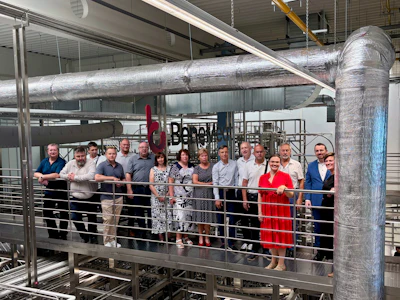
BeneMeat hosted the Czech Meat Processors Association at its Prague pilot facility to demonstrate cultivated meat technology and foster dialogue between the conventional and innovative meat industries. The company positions cultivated meat as a complement rather than competition to traditional meat production, emphasizing the importance of open communication and transparent regulatory frameworks.
- Facility Tour: BeneMeat's pilot production facility showcased cultivated cell technology and manufacturing processes designed for future industrial-scale production.
- Industry Collaboration: Czech Meat Processors Association leadership engaged in professional discussions about cultivated meat's potential role as a complement to conventional meat production.
- Regulatory Focus: Product labeling and transparent communication with consumers were key discussion points, with emphasis on compliance with existing legislation.
- Strategic Vision: BeneMeat CEO Roman Kříž called for Europe to accelerate support for biotechnology innovation to remain globally competitive against the United States and China.
- Continued Engagement: Both parties committed to ongoing professional dialogue between conventional meat producers, academia, and cultivated meat technology companies.
BeneMeat hosted representatives of the Czech Meat Processors Association at its pilot production facility in Prague, Czech Republic in June to discuss cultivated meat technology and the regulatory framework surrounding cultivated meat products.
Czech Meat Processors Association Chairman Jaromír Kloud and Executive Director Radek Slanec led the delegation's visit, which included a tour of BeneMeat's pilot production facility and meetings with company experts on cultivated cell technology and its potential future applications.
BeneMeat said it considers open dialogue with the conventional meat industry an important part of the sector's development.
"We do not see cultivated cells as competition to conventional meat production, but rather as its natural complement," said Roman Kříž, CEO of BeneMeat. "Our goal is to provide an additional technological option that can help expand the traditional product portfolio in the future. That is why we consider open dialogue with the entire meat industry absolutely essential.
"We greatly appreciate the opportunity to welcome representatives of the Czech Meat Processors Association to our facilities, and we believe this meeting marks the beginning of long-term cooperation built on professional discussion, knowledge sharing and mutual understanding," Kříž added. "We would also welcome similar dialogue between other cultivated meat companies and the conventional meat sector."
Radovan Čadek, director of production at BeneMeat, led guests on a tour of the pilot production facility, giving them a first-hand look at the manufacturing process and the technology BeneMeat is developing for future industrial-scale production.
"We greatly appreciate the opportunity to present our technology to professionals who have dedicated their careers to the meat industry," Čadek said. "The best way to answer questions and address concerns is to show the technology first-hand and openly discuss every aspect of the production process."
BeneMeat said the scale of its pilot production module reflects the progress of the cultivated meat industry, adding that current facilities are designed for further scale-up and commercialization rather than small-scale laboratory work.
Product labeling was also a focus of the meeting. BeneMeat said it supports clear and transparent communication with consumers while complying with existing regulatory requirements.
"For the general public, the term cultivated meat is the clearest way to describe both the technology and the final product," said Marek Širl of BeneMeat. "On BeneMeat products, however, we use the designation cultivated cells together with the origin of the cells, fully in line with current legislation and regulatory requirements."
Kříž also addressed the broader regulatory environment for cultivated meat in Europe.
"Europe has world-class scientists, outstanding research capabilities and cutting-edge technologies," Kříž said. "However, maintaining this leadership position requires not only evidence-based discussion but also an environment that genuinely supports innovation.
"While countries such as the United States and China recognize modern biotechnology as a strategic priority and actively support its development, Europe continues to move much more slowly," Kříž continued. "If we want to remain globally competitive, we must begin acting accordingly. In line with our Ethical Codex, BeneMeat has chosen not to rely on public funding for its own development. At the same time, we believe future support programs should exist for companies willing to implement these technologies and invest in bringing them into industrial practice."
Slanec said the Czech Meat Processors Association plans to continue engaging with cultivated meat developers.
"We would like to thank BeneMeat for the invitation and the opportunity to experience its pilot production facility and cultivated cell technology first-hand," Slanec said. "We appreciated the open and constructive discussion that truly reflected the spirit of dialogue instead of prejudice. We believe that only professional debate based on verified facts, mutual respect and transparency can provide an objective assessment of new technologies and their potential role in the future of food production.
"The Czech Meat Processors Association will continue supporting open communication between representatives of the conventional meat industry, academia and innovative technology companies," Slanec added.