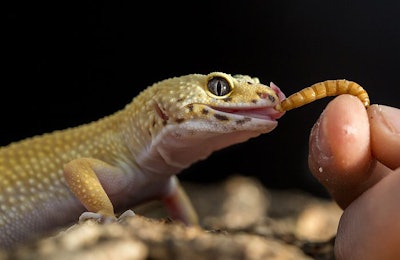
In the European Union, the use of insects in pet foods faces one of the same barriers as in the United States and the rest of the world: lack of large-scale, consistent supply. One French company, Ynsect, aims to change that by producing enough yellow mealworms (Tenebrio molitor) to meet Europe’s pet food industry demands. However, although the technology exists and mealworms already appear in pet reptile, fish and bird diets, there are still not enough insect farms for the dog and cat food market.
Mealworms have a decades-long history in the pet industry already, said Constant Motte, business development manager for Ynsect at Clextral’s Animal Feed Extrusion Course on October 16 in Saint-Etienne, France. Mealworm farms produce approximately 500 tons per year, and have done so for more than fifteen years.
Reptile, bird and fish owners have fed those mealworms to their anoles, finches and predatory piscine pets for many years, but the size of that market pales in comparison to the dog and cat food market. To provide a constant supply of mealworm protein as an alternate protein source in dog and cat food, mealworms farms must scale up.
Mealworm farms for pet food protein
To do that, Ynsect holds 23 patents on their fully automated mealworm farms. In those facilities, 50-meter-tall trays raise millions of mealworms. Mealworms are the larval stage of a type of darkling beetle. Since those larvae are nocturnal and do not fly, mealworm farms don’t need as much lighting or controls to stop the creatures from flying away.
Ynsect’s mealworm farms follow a process that eventually yields both YnMeal, a powdered protein source and YnOil, which is similar to peanut oil and rich in healthy fatty acids. Along with those two edible products, Ynsect also sells used bedding as a fertilizer.
Nutritionally, YnMeal consists of approximately 70 percent protein, 13 percent fat, 3 percent water and 8 percent fiber. What’s more, that protein is hypoallergenic, may reduce flatulence and may have prebiotic effects due to its content of chitin, peptides and nucleotides, said Motte.
About Ynsect mealworm farms
Ynsect was founded in 2011 and now had 104 employees. The company has raised EUR 40 million since 2014, making it the largest in the yellow mealworm industry, said Motte. The company’s first mealworm farm-hill was built near the town of Dole, in the Burgundy-Franche-Comté region of France.