Kormotech's Unbroken Animals program pairs dogs with Ukrainian veterans
The Unbroken Animals program in Lviv, Ukraine, established by Kormotech, pairs specially trained dogs with veterans and their handlers to support physical and emotional rehabilitation.
September 21, 2026
Since the start of the full-scale war, Unbroken Animals has helped approximately 300,000 animals, distributing 2,400 metric tons of pet food, providing more than 31,000 vaccinations and helping find new homes for more than 2,940 animals.
Kormotech
Kormotech's Unbroken Animals program pairs service dogs with Ukrainian veterans to provide emotional support during rehabilitation, helping wounded soldiers regain motivation and overcome fear during physical recovery exercises.
The Unbroken Animals program launched in Lviv with 10 handler-dog pairs providing emotional support to veterans during rehabilitation
Dogs are selected based on temperament, vaccination status, and readiness for work, with handlers assessed for motivation and experience
The program's methodology was developed by Kateryna Bieliaieva, who has made over 2,000 therapeutic dog visits to hospitals and rehabilitation centers since 2019
Training lasts approximately two months and includes theoretical instruction and practical sessions where veterans work with dogs on motor skill and coordination exercises
U-Hearts has supported approximately 300,000 animals since the full-scale war began, distributing 2,400 metric tons of pet food and providing over 31,000 vaccinations
In Lviv, the first participants have begun training as part of Unbroken Animals, a program that provides emotional support to veterans, service members and their families with the help of dogs. As part of the program, participants and their dogs undergo training to assist patients at the UNBROKEN rehabilitation center in their recovery.
The first cohort includes 10 participants and their dogs. During training, they undergo theoretical instruction and practical sessions with veterans under the guidance of dog trainers.
The Unbroken Animals program was established by Kormotech and initiated by the animal welfare platform U-Hearts, formerly known as the Save Pets of Ukraine initiative. Since the start of the full-scale war, the platform has helped approximately 300,000 animals, distributing 2,400 metric tons of pet food, providing more than 31,000 vaccinations and helping find new homes for more than 2,940 animals.
Bentley is a Belgian Malinois who also serves with the Kyiv Region Police and works alongside Kateryna Bieliaieva. Bentley detects explosives and weapons. During the full-scale war, he worked at checkpoints and took part in searches and demining operations in the Kyiv Region. KormotechThe role of dogs in the recovery process
At the center of Unbroken Animals is the "Companions" training program, which was launched by U-Hearts. The program pairs people, known as handlers, with companion dogs in the rehabilitation process. They work with rehabilitation specialists, who decide which movements a patient needs to perform for physical recovery. The program team then builds the dog interaction around those movements.
"A person might spend half a year, a year, or even two at the rehabilitation center and, at some point, lose the motivation to do the necessary physical exercises — especially when they're associated with pain," said Iryna Lozova, head of social projects at U-Hearts. "Veterans often lack the emotional component that would serve as an incentive to continue their sessions. At Unbroken Animals, that element is interaction with a dog."
After being wounded, a person may find it difficult to work with someone who is physically healthy and sets challenging tasks for them. An animal does not judge a person or demand results, so interacting with a dog can relieve internal tension, according to the program.
A dog can also help a veteran attempt tasks they are afraid to try. "One of the program participants, Ivan (name changed), recently received a prosthetic arm but was afraid it might come loose," Lozova said. "While playing with the dog, that fear faded into the background: The veteran began throwing a ball to her with his prosthetic arm, making movements he had previously avoided."
Asya ended up in Kateryna's team by chance. At the time, Kateryna was taking her sick dog around to various clinics — the dog had lung cancer. At one of the traffic lights, she saw a bag fall out of the car in front of her onto the curb; she went over to look and found a little puppy inside. She called a few animal shelters, but nobody answered. So the puppy stayed with her, and in time Asya became part of Unbroken Animals.KormotechHow the Unbroken Animals method came about
The program's methodology was developed by Kateryna Bieliaieva, a senior inspector at the Kyiv Region Police Canine Center. Since 2019, she has used dogs to provide emotional support to people recovering from war-related trauma. During that time, she has made more than 2,000 visits with dogs to hospitals, military hospitals and rehabilitation centers.
"During rehabilitation, a lot of attention is paid to physical, psychological and cognitive recovery, while the emotional sphere often remains out of focus. Yet it plays a crucial role in a person's recovery," Bieliaieva said. "Our goal is to engage their emotions and encourage participants to do exercises they wouldn't do without the dogs."
Bieliaieva recalled a veteran who, after suffering numerous concussions, could not walk straight on his own but refused help and did not want to interact with anyone. He did interact willingly with the police dog Vanda, who would take him by the sleeve of his jacket and lead him along; he would reward her with treats. His interactions with the dog became his motivation to move.
Selection of handler-dog teams
The program accepts physically healthy dogs at least 2 years old that are fully vaccinated and show no signs of aggression. In the first round of selection, the team received 124 applications. Organizers assessed the motivation and prior experience of prospective handlers, as well as the animals' readiness for the work. After several stages of selection, 10 pairs were accepted into the training program.
One participant is traumatologist Ostap Zubach, who joined the program with his 7-year-old Labrador named Ami.
"Right now, we're dealing with a very large number of injured people — both military personnel and civilians — and the injuries themselves are often extremely complex. Doctors primarily address the physical consequences, but a person's recovery isn't limited to that," Zubach said. "For me, this project is an opportunity to complement physical rehabilitation with emotional support. I'm learning to interact better with patients, understand their emotional state, and help them recover. We have a long road ahead."
Training lasts about two months and consists of a theoretical component and practical sessions with veterans and service members under the supervision of specialists. During the practical sessions, UNBROKEN patients get to know the animals, pet them and give them treats before moving on to simple tasks related to developing motor skills and coordination. For example, a person needs to hold onto a toy while a dog pulls on it.
"First and foremost, we teach people to understand their dog's behavior. The dog's well-being is one of the program's key principles," Lozova said. "If the animal is uncomfortable or the workload proves to be too much for it, the pair stops participating, even if they're showing good results."
Expansion of the Unbroken Animals program
The pilot program in Lviv will run from July through November 2026. This fall, U-Hearts also plans a similar recruitment drive in Kyiv, again for 10 pairs. Organizers said that group size allows for quality training of participants without overburdening either the people or the animals.
"There is a great need for new approaches to rehabilitation right now, so it's important for us not just to conduct a single pilot but to gradually share the experience we've gained," Lozova said.
The Unbroken Animals project is being implemented by the NGO Pro Lviv in collaboration with LKP Lev, UNBROKEN, the NGO U-Hearts Ukraine, the Lviv Bureau for European Integration and the Department of Investments and Projects of the Lviv City Council as part of the U-LEAD with Europe program, which is run with the support of the European Union and its member states: Germany, Denmark, France, Austria, Poland and Slovenia.
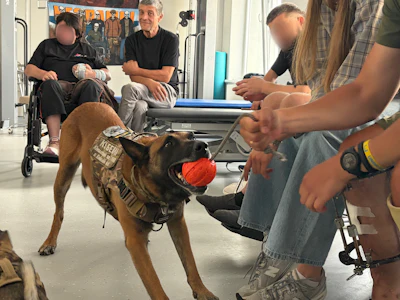
 Bentley is a Belgian Malinois who also serves with the Kyiv Region Police and works alongside Kateryna Bieliaieva. Bentley detects explosives and weapons. During the full-scale war, he worked at checkpoints and took part in searches and demining operations in the Kyiv Region. Kormotech
 Bentley is a Belgian Malinois who also serves with the Kyiv Region Police and works alongside Kateryna Bieliaieva. Bentley detects explosives and weapons. During the full-scale war, he worked at checkpoints and took part in searches and demining operations in the Kyiv Region. Kormotech
 Asya ended up in Kateryna's team by chance. At the time, Kateryna was taking her sick dog around to various clinics — the dog had lung cancer. At one of the traffic lights, she saw a bag fall out of the car in front of her onto the curb; she went over to look and found a little puppy inside. She called a few animal shelters, but nobody answered. So the puppy stayed with her, and in time Asya became part of Unbroken Animals.Kormotech