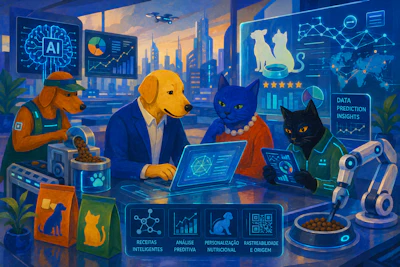
Artificial intelligence (AI) has long evolved beyond a tool for writing emails or transcribing meetings. In the pet food sector, it now occupies strategic roles that support management, reduce costs, optimize supply chains and enable the creation of new service categories. Still, adoption across the industry remains far from uniform.
In Brazil, the technology presents a mixed landscape. AI is already deeply embedded in the country’s broader digital culture — Brazil was ranked the world’s most AI-obsessed country in a January 2026 report from cybersecurity company Check Point Software — but the pet food industry is moving at very different speeds when it comes to implementation.
Petfood Forum Brasil spoke with four Brazilian manufacturers to understand how AI is being used within their operations. Overall, companies with Brazilian roots are still evaluating the technology or have yet to implement integrated AI initiatives. Meanwhile, multinational manufacturers are already using AI to support large-scale industrial projects, while foodtech startups view the technology as a strategic accelerator.
Multinational companies lead digital transformation
Global players in the sector are already making extensive use of AI-driven automation in their Brazilian operations. Nestlé Purina, for example, invested R$2.5 billion in a new megafactory in Vargeão, Santa Catarina, designed entirely around Industry 4.0 principles. The facility operates fully paperless and uses advanced robotics integrated with AI in pouch filling and packaging lines.
Another example of AI maturity in the industry is predictive maintenance. WEG, a global machinery manufacturer, implemented an automated asset management and sensor system at a major Brazilian pet food company to monitor critical milling equipment.
Using AI-powered software, the system identified early-stage issues such as rotor misalignment and imbalance, preventing shutdowns that could have halted operations for days. According to WEG, the solution increased productivity by 17% and generated estimated annual maintenance savings of R$660,000.
In customer engagement, Italian manufacturer Farmina stands out for its use of AI. The company’s automated chatbot operates as a 24/7 pet nutrition and health specialist, offering personalized guidance based on pets’ needs and lifestyles.
Brazilian manufacturers are still in the early stages
Among Brazilian-owned manufacturers, however, AI has yet to become part of the “workforce.” Special Dog Company, a pet food and treats manufacturer based in São Paulo state, said in a statement that it currently has no advanced AI projects underway.
The same applies to BRF Pet, the pet food division of MBRF. According to company representatives, the business has no AI-based production or operational initiatives specifically within the pet segment, although broader corporate initiatives exist at the group level.
PremieRpet, one of Brazil’s pioneers in premium pet nutrition, said it has already introduced AI solutions in some departments, though still at an early stage.
Startups move to the forefront
At the other end of the market, pet food startups and foodtech companies see AI as part of their operational core. One example is A Quinta, a manufacturer of natural, wet and personalized dog foods, which uses AI to improve logistics, communication and marketing efficiency.
In a statement, the company said AI mainly helps reduce operational complexity by organizing information, standardizing processes and accelerating communication. The technology also streamlines internal workflows that would otherwise be slower and more prone to errors.
“In a business model like ours, which involves personalization, recurring production and distribution, these gains are essential to maintaining consistency, predictability and quality in every delivery,” said Tiago Tresca, CEO and co-founder of the company.
AI is not a passing trend
According to Brenda Garofalo, technical coordinator for animal nutrition, R&D and regulatory affairs at Vertrauen Consultoria Pet, in an article published by Editora Stilo, AI is not a temporary trend within the pet market. “It is the infrastructure on which the industry’s next generation will be built,” she wrote.
The convergence between the growing emotional bond with pets and the analytical power of AI is creating a new paradigm centered on preventive medicine, precision nutrition and holistic well-being.
Still, Garofalo said the road ahead requires a strategic approach that places data at the center of the business while respecting ethical and regulatory boundaries. Compliance with Brazil’s General Data Protection Law (LGPD), particularly in handling data related to pet owners and their dogs, is emerging as a significant regulatory challenge.
At the same time, critical decisions involving animal health and care continue to require human judgment.
“Technology supports the process, but critical decisions remain human, based on technical criteria and care for animal health,” Tresca added.
Even so, opportunities remain substantial for companies capable of navigating technical complexity and delivering solutions that genuinely translate data into better quality of life for pets and greater peace of mind for owners.