During a recent Ask the Petfood Pro, Bill Barlow, senior market development manager at Printpack, spoke on the market forces reshaping pet food packaging.
From fresh food's packaging demands to the promise and limitations of recyclable flexible films, Barlow offered a candid assessment of where the industry stands today and where brands need to focus next.
Here are 10 takeaways from the latest Ask the Petfood Pro, “From pouches to purpose: Packaging trends shaping pet care’s future.”
1. The pet food market is resilient but restrained
Despite reaching an estimated $43 billion in market size, the pet food category grew just over 1% last year — a slight slowdown. Barlow cited inflation, consumer caution, softening labor markets and new tariffs as headwinds.
"The pet food market seems resilient right now, even though growth is not as big as we've seen in the past," he said. That environment, he noted, is pushing interest toward smaller, lower-price-point pack formats that better fit consumer budgets.
2. Fresh pet food is going mainstream — and packaging must keep up
Fresh pet food is no longer a niche segment, and its packaging requirements are fundamentally different from dry kibble. Barlow pointed to the need for higher barrier structures, hermetic seals, gas flushing and retortable options for shelf-stable products, plus the added challenge of packaging that must withstand freeze-thaw cycles and repeated refrigeration.
"We have to almost start from scratch," he said, noting that traditional polyester, polyethylene or woven polypropylene structures designed for dry kibble may no longer be adequate.
3. Multi-form feeding is creating new packaging families
A majority of cat and dog owners now use dry food as a foundation and mix in wet foods and toppers. Barlow sees this as a significant design opportunity: brands can connect packaging across product lines through color, format and design — creating cohesive "packaging families."
He described a modular approach as one possibility: "a large stand up pouch for kibble, a medium size for a retort wet food, and then a smaller pouch or stick pack for a topper, that could all be complimentary to each other."
4. Packaging is a strategic canvas, not just a container
Barlow was emphatic that packaging's role extends far beyond product protection. "Packaging is not just a vessel to store and transport the product,” he said. “It is a canvas that can help tell a story and communicate to the consumer the benefits of that product."
He pointed to clear windows, clean-label communication and keywords such as "humanely raised," "ethically sourced" and "upcycled" as tools brands are increasingly using to differentiate on-shelf.
5. Convenience features are table stakes for modern consumers
Easy-open and reclose features, portion control, on-the-go formats and tactile finishes are resonating broadly with today's pet owners. Barlow highlighted growth in single-serve and lickable treat formats, particularly in the cat segment, and noted the rise of single pet parents who travel with their animals as a driver of demand for portable packaging. "Having on-the-go packaging is certainly important," he said.
6. Recyclable flexible packaging is advancing — slowly
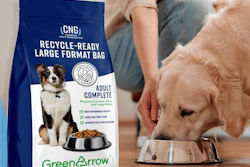
Recyclable polyethylene remains the top sustainability priority for pet food brands, but adoption is still low. Barlow acknowledged performance trade-offs in barrier, heat resistance, stiffness and ease of opening, and noted that supply chain infrastructure for machine-direction oriented and biaxially oriented PE films has not yet reached the scale needed to drive down costs.
He noted Printpack is actively commercializing recyclable stand-up pouches, flat-bottom bags and quad-seal bags with three major brands.
7. E-commerce is exposing gaps in flexible packaging performance
Direct-to-consumer shipping puts packaging through significantly more abuse than traditional retail. Barlow estimated two to three times more handling touchpoints. He identified e-commerce durability as an area where flexible packaging is currently falling short, calling out burst risk, seal failures and puncture resistance as specific concerns.
Barlow also sees an opportunity to develop simplified, lower-graphic SKUs for online-only channels: "When people are buying online, they know what product they're going to buy," he said. "As long as they're getting that product, they don't need the fancy design."
8. Digital printing is opening doors for speed, personalization and sustainability testing
Digital printing enables short runs, fast speed-to-market and individualized packaging, including variable designs with pet names, breeds or feeding tips, without the commitment of a full production run.
Barlow said Printpack can turn around digitally printed recyclable materials in two to three weeks. "It's a great way to do something fast and test something with minimal risk," he said. He also flagged augmented reality integration as an emerging possibility for brand interaction.
9. Premiumization and humanization are driving packaging aesthetics
As pet humanization continues, brands are increasingly borrowing cues from human CPG packaging. Barlow noted that matte soft-touch finishes, metallic reveals, spot gloss effects and tactile elements help convey premium quality before a consumer even reads the label.
He also emphasized shelf differentiation. "Look at the shelf and see what may help differentiate your packaging next to your competitors," he said, citing unconventional shelving orientations and format changes as low-cost ways to stand out.
10. Gen Z pet owners are the critical growth target — and packaging must speak to them
Barlow closed with a clear directive: design for the next generation of pet owners. Gen Z buyers, he said, are more open to premium products, multi-form feeding and brand switching. They are also more likely to try something new if the entry pack size is small and the financial commitment is low.
"Consider smaller packaging, portion size," he said. "There's less commitment to try something new if you don't have to buy 10, 20 or 30 pounds of product."
To see the on-demand session recording of this Ask the Petfood Pro or learn about upcoming chats, click here.