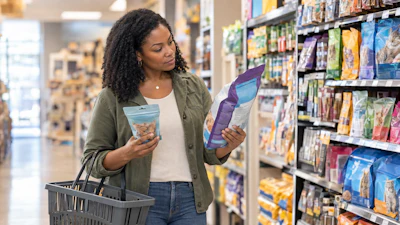
Private label pet products are rapidly gaining market share as consumers demand premium quality at affordable prices, driven by functional benefits, ingredient transparency, and value-forward premiumization that makes quality nutrition accessible rather than exclusive.
- Private label pet product unit sales grew 5.4% in 2025, with treats jumping 67% and supplements rising 39% year-over-year.
- 77% of global pet owners agree it's worth paying more for products with functional benefits like digestive health, longevity, and immune support.
- 62% of global pet owners cite ingredient lists as the primary reason they switch brands, with 67% of U.S. pet owners trusting branded ingredients over generic alternatives.
- Private label pet care now accounts for 18.1% of total private label unit sales, with growth spanning Walmart, Dollar General, and Amazon.
- The shift toward value-forward premiumization means consumers expect elevated nutrition and quality packaging at accessible costs, moving away from brand exclusivity.
Private label pet products are moving beyond their entry-level image as pet owners look for premium quality without premium prices, according to ADM's 2026 Private Label Pet Market Report.
"Quality and affordability are no longer opposing forces," the report stated. "They are expectations that must coexist."
The report, authored by Colton Clason, who handles marketing strategy for ADM's B2B pet nutrition team, draws on ADM's own consumer research along with data from the Private Label Manufacturers Association (PLMA), Numerator and Innova.
Nutrition and price both drive purchases
Citing ADM's Outside Voice Global Lifestyle Survey from 2025, the report found that 67% of global dog and cat owners want "good nutrition with nothing bad for my pets," while 62% want pet food that is "well made with high-quality ingredients." Nearly half, 49%, said they want good value for their money and prefer a low price.
Price also shapes where pet owners shop. According to Numerator's 2025 Pet Trends Report, cited by ADM, 62% of Amazon shoppers said price is the most important factor when choosing a retailer for pet products.
The report described the trend as "value-forward premiumization," in which consumers expect elevated nutrition, carefully selected ingredients and quality packaging at an accessible cost.
"The definition of 'premium' is evolving, shifting away from exclusivity and toward accessibility," the report stated.
Economic pressure has accelerated that shift, according to the report, with pet owners comparing labels, formulations and price per ounce rather than defaulting to established brands.
Store brands gain ground
Citing PLMA's 2026 Private Label Report, ADM noted that store brand dollar sales in U.S. retail rose 3.3% across all categories in 2025, nearly triple the 1.2% growth posted by national brands.
Private label pet care unit sales grew 5.4% in 2025, and pet care now accounts for 18.1% of total private label unit sales, according to the PLMA data cited in the report.
Treats and supplements led growth within the category. Private label pet treat unit sales jumped 67% in 2025 compared with 2024, and pet supplement unit sales rose 39% year over year, the report stated. ADM attributed the supplement gains to pet owners' growing focus on proactive health, wellness and longevity.
The growth spans retail channels. Walmart and Dollar General are seeing notable growth in private label pet sales, while Amazon purchases of pet products continue to rise, according to Numerator data cited in the report. "Private label success is no longer channel-specific," the report stated.
Functional benefits carry weight
According to ADM's survey data, 77% of global pet owners agreed it is worth paying more for pet products with functional benefits. The top health concerns among global pet owners were digestive health at 40%, longevity at 38%, immune health at 34%, and joint and bone health and dental health at 31% each.
The report identified four areas where private label products can strengthen perceptions of quality:
- Higher protein inclusion or named protein sources.
- Functional claims such as gut health, calming and mobility.
- Clean label positioning with no artificial additives.
- Packaging that matches national brand design standards.
Ingredient transparency builds trust
Trust is a key factor in whether pet owners try a new product, according to the report, which noted that 56% of U.S. pet owners consider their pets family.
Ingredient lists play a central role. Citing Innova's 2025 Pet Owners Survey, the report found that 62% of global pet owners name ingredient lists as the primary reason they switch pet food brands. In addition, 67% of U.S. pet owners said they trust products with branded ingredients more than generic alternatives, according to ADM research conducted through Morning Consult.
Because shoppers link store brands to the retailer's own reputation, consistent quality across nutrition, transparency and presentation is critical, the report stated. When private label products deliver on those points, the report concluded, "choosing store brand becomes a smart, confident choice rather than a trade-off."