On March 13, the U.S. Food and Drug Administration issued an advisory warning that eight lots of Quest Cat Food, marketed by Go Raw LLC doing business as Steve's Real Food, contain extremely low or no thiamine (vitamin B1), a nutrient essential to feline health.
FDA testing was initiated after the agency received a report from a veterinary neurologist describing severe thiamine deficiency symptoms in a cat that had consumed one of the affected lots. Additional consumer complaints of cat illnesses linked to Quest Cat Food prompted further testing. All eight lots tested by the FDA contained thiamine levels well below the Association of American Feed Control Officials (AAFCO) minimum of 5.6 mg per kg of food on a dry matter basis.
 FDA
FDA
The affected products — sold as frozen and freeze-dried nuggets in multiple protein varieties — carry nutritional adequacy statements indicating they are formulated to meet AAFCO Cat Food Nutrient Profiles for all life stages. The FDA noted that despite those label claims, cats consuming the products as a sole food source have experienced thiamine deficiency symptoms.
The FDA recommended that Go Raw LLC recall all eight lots. As of the advisory's release, Steve's Real Food had recalled only three. Although the company publicly stated it is halting sales of all Quest Cat Food until the thiamine issue is resolved, it has not provided the FDA with evidence that the remaining lots have been removed from commerce or that customers have been adequately notified of the affected products and associated risks.
Product details
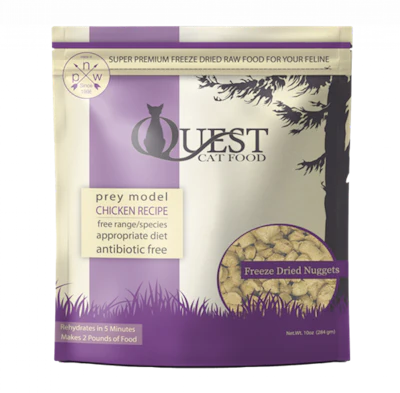
Quest Cat Food is sold online and through retail stores nationwide. Freeze-dried products are sold in 10-ounce beige zip-top bags; frozen products are sold in 2-pound beige zip-top bags. Bag label colors vary by protein: purple for chicken, orange for pork, blue for white fish and pink for beef. Date codes are printed on the front of each bag. Consumers who no longer have the packaging or cannot read the lot code should assume the product may not contain adequate thiamine levels.
Clinical signs of thiamine deficiency
Early-stage thiamine deficiency in cats may present as decreased appetite and vomiting. In some cats, symptoms can appear within one week; in others, onset may take months. As the deficiency progresses, cats may develop cervical ventroflexion (a downward bending of the neck with inability to raise the head), muscle weakness, loss of appetite, wobbly gait, falling, seizures and circling. Untreated, the condition can be fatal. When caught early, thiamine deficiency symptoms typically resolve with dietary changes.